Terpenes are aromatic compounds found in cannabis and many other plants, and they help shape the earthy, citrusy, herbal and spicy notes people associate with weed. Myrcene, limonene and beta-caryophyllene are three commonly discussed cannabis terpenes, but their names and percentages cannot predict a flower’s complete scent or establish its quality.
At High Society, we want terpene names to make flower descriptions clearer, not harder to decode. A profile is a useful starting point for aroma vocabulary, but it is not a prediction of the finished scent. Here is how to read one without filling in information that is missing.
Five checks for a terpene list:
- Identify the sample. Is this a specific batch or a general variety description?
- Read the names. Note the compounds actually reported.
- Check the unit. Is each number a flower-weight percentage or a share of the reported terpene total?
- Compare like with like. Check that reports use a comparable basis and measured compound list.
- Leave room for aroma. A lab profile is not a complete sensory description.
What are terpenes in weed?
Terpenes are a large family of molecules made by plants. You already encounter them in everyday aromas such as citrus peel, herbs, hops and spices. Cannabis produces many terpenes too, along with other fragrant compounds. The mixture is part of why one flower may smell earthy while another has a sharper, citrus-like edge.
In cannabis flower, many terpenes occur in resin-rich structures. A named terpene on a description or test report is one measurable part of the plant’s chemistry, not something exclusive to cannabis.
What do myrcene, limonene and caryophyllene smell like?
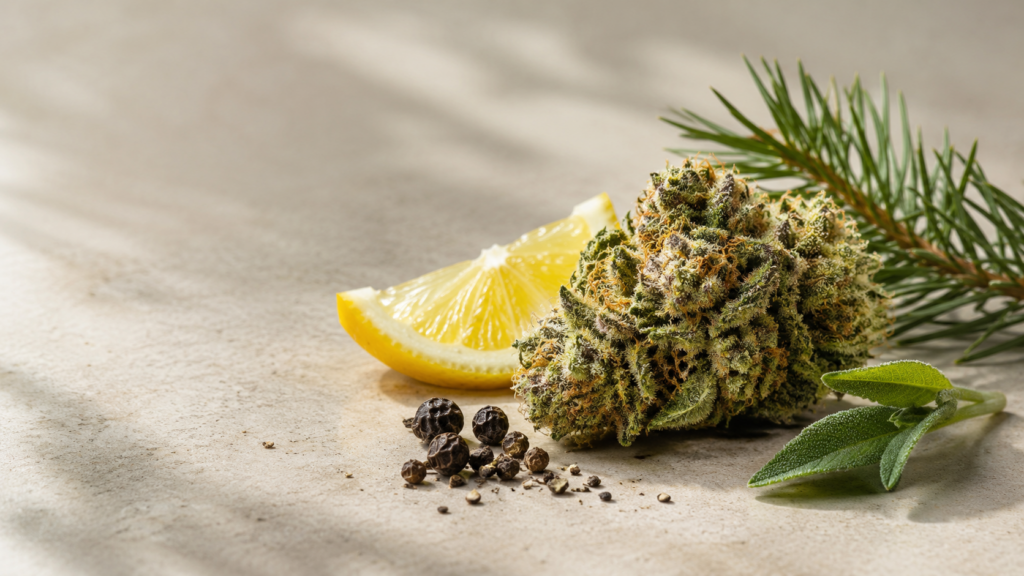
These three compounds are familiar reference points: myrcene is often earthy or musky, limonene citrus-peel-like, and beta-caryophyllene peppery or spicy. These words describe typical associations with individual compounds, not guaranteed flower aromas.
| Terpene | Typical aroma words | Familiar comparison | What the name cannot establish |
|---|---|---|---|
| Myrcene | Earthy, musky, herbal; sometimes fruity | Hops and some aromatic herbs | That every flower containing it smells earthy |
| Limonene | Citrus, lemon or orange peel | Fresh citrus rind | That a flower has a clearly lemon-like aroma |
| Beta-caryophyllene | Peppery, woody, warm spice | Black pepper and clove-like spice | That pepper will dominate the whole aroma |
On a phone, swipe the table sideways to read each column.
- AROMA NOTE 01Myrcene
Earthy · musky · herbal
A single named compound
- AROMA NOTE 02Limonene
Citrus peel · bright rind
A single named compound
- AROMA NOTE 03Beta-caryophyllene
Pepper · woody spice
A single named compound
Other terpenes, lower-abundance aromatic compounds, growing and post-harvest conditions, and age can change what you smell. The three notes above are associations, not quantities or a prediction for any particular flower.
Myrcene also gets compared with tropical fruit in some descriptions, but its presence does not mean a flower must smell like mango. The familiar earthy, herbal and musky words are starting points, not a finished aroma.
Limonene has a recognizable citrus association, although an orange-like or tropical smell in flower can involve other volatile molecules too. A named compound alone cannot identify the whole scent.
Beta-caryophyllene is commonly linked to black-pepper and woody-spice notes. A description may shorten it to “caryophyllene,” but for numerical comparisons use the exact compound name printed in the report.
What about other names? Pinene is associated with pine-like notes, linalool with floral or lavender-like notes, and terpinolene with a mix often described as herbal, floral or citrus-like. They are useful supporting examples, not a second list of guaranteed flower scents.
Why can two cannabis flowers have different aromas?
Because the overall scent comes from a mixture, not one dominant number. Proportions vary between flowers, and handling, drying, storage and age can change the aroma that reaches your nose. Two flowers with similar leading terpenes need not smell alike.
Terpenes are only part of the picture. Other fragrant molecules, including some sulfur-containing compounds, can add distinctive notes even when they appear in small amounts. That is why a short list of the leading terpenes may not tell you exactly what a flower will smell like.
Even two flowers with similar leading terpenes can smell different when you compare them side by side. A lab profile describes part of their chemistry, while the scent you notice comes from the full combination of aromatic compounds. Both kinds of information can be useful, but one cannot replace the other.
What can a cannabis terpene profile actually tell you?
A terpene profile lists the compounds a laboratory or producer reports, usually with amounts or proportions. Flower chemistry can vary between samples, including flowers that share a familiar variety name. Start with information for the specific flower or batch you are comparing instead of treating a general description as a guaranteed match.
For a direct comparison, ask whether the two reports cover the same compounds, use the same units and describe specific batches. Some product descriptions show only leading terpenes, and some test panels do not measure every aroma-active substance. An omitted name is not proof that a compound is absent.
A general variety description is not a substitute for a test result from a specific batch, and neither is a sensory review. Use each for the question it actually answers.
What does a terpene percentage on a flower report mean?
A percentage needs a denominator. On a weight-based flower report, an individual terpene percentage may describe its proportion of the tested flower by weight. A separate chart might instead describe that compound’s share of all measured terpenes. Both can be valid, but they answer different questions.
0.42 ÷ 1.40 × 100 = 30%
30% is myrcene’s share of the measured terpene total, not its percentage of the flower. Here is a complete, hypothetical distribution on the same flower-weight basis:
- Myrcene 0.42% of flower30% of measured total
- Limonene 0.28% of flower20%
- Caryophyllene 0.14% of flower10%
- Other measured terpenes 0.56% of flower40%
When a report uses mg/g instead of percent by weight, the units must be converted before comparing. For the same weight basis, 10 mg/g equals 1%; reported totals also depend on which compounds were measured. Do not compare unlike panels as if they were identical.
Does a higher terpene percentage always mean better flower?
No. A bigger reported total does not establish that one flower is better than another. “Better” might refer to a scent you enjoy, the flower’s condition, consistency, or some other personal preference. None of those can be reduced to a single terpene number.
Reports may cover different compounds or use different sampling methods. Some aroma-active molecules are noticeable at low amounts, so the largest laboratory number is not necessarily the note someone perceives most strongly.
How are terpenes different from THC and CBD?
Terpenes are one group of compounds associated with plant aroma. THC and CBD are cannabinoids, a different chemical category. A flower can have cannabinoid results and terpene results on the same report, but those measurements should not be mistaken for one another.
THC percentage does not tell you whether flower will smell citrusy; limonene does not tell you how much THC it contains. Our THCA vs THC guide covers cannabinoid terminology separately.
Likewise, a terpene profile does not independently establish an indica, sativa or hybrid label. For that different question, see our indica vs sativa vs hybrid explainer.
What should you check when comparing terpene information?
When you have two descriptions side by side, compare their evidence first, not just the numbers. Check these five details:
- Look for the complete name. Myrcene, limonene and beta-caryophyllene are not interchangeable with every similarly named compound.
- Look for the measurement basis. An individual flower-weight percentage is different from a share of the measured terpene total.
- Look for the batch context. The same variety name does not guarantee identical values in a separate harvest or sample.
- Look beyond one leading result. The other listed compounds, and some compounds not included in the panel, can contribute to aroma.
- Keep aroma separate from promises. A terpene profile can inform a description without establishing quality or a predictable experience.
When you’re exploring High Society’s Flower category, use any available aroma descriptions as descriptive information rather than assuming that every listing includes a laboratory-tested terpene breakdown. Availability, reporting detail and the flower itself can differ; do not fill in missing facts from another product.
What else do people ask about cannabis terpenes?
Are terpenes only found in weed?
No. Plants such as citrus, herbs and hops also produce terpenes. Their presence in cannabis is not unique, although each flower can have its own combination of aromatic compounds.
What does “dominant terpene” mean on a report?
It usually refers to the terpene with the highest reported amount among those measured. It does not establish the flower’s strongest perceived scent, and the ranking can change if the test panel differs.
What is the difference between mg/g and a terpene percentage?
They can express an amount on different scales. On the same flower-weight basis, 10 mg/g equals 1% by weight. Check units and test definitions before comparing two results.
Is a 2% terpene flower automatically better than a 1% flower?
No. Those totals alone cannot establish aroma appeal or overall quality. Check what was measured, how results are reported and what other information is available about the flower.
Can I identify a terpene profile by smelling the flower?
You can describe a flower’s aroma, but you cannot reliably calculate its chemical percentages by smell. A laboratory profile and a sensory description offer different kinds of information.
What is the simplest way to understand cannabis terpenes?
Use myrcene, limonene and beta-caryophyllene as aroma vocabulary, then check the report’s units, batch and measured compounds. No single percentage can replace the flower’s complete scent.
At High Society, we prefer a clear description over a sweeping promise. The useful question is simple: what does this particular flower’s profile actually tell you?