High Society Cannabis Co. · Orange County cannabis education · Research checked November 23, 2026
THCA vs THC in plain English: THCA (tetrahydrocannabinolic acid) is an acidic cannabinoid naturally found in cannabis, especially in material that has not been heated. Delta-9 THC is the intoxicating cannabinoid commonly associated with feeling high. When THCA is heated, some of it can convert into delta-9 THC. That is why a flower label can show a high THCA percentage, a much lower delta-9 THC percentage, and a separate Total THC value. These numbers describe different things; none can predict exactly how someone will feel. [1][3]
At High Society, we work with cannabis terminology every day, and we know how confusing a label can be. You might see “24% THCA” on one flower listing, “THC” on a vape product and “Total THC” on a laboratory report. They are related, but they are not interchangeable. Here in Orange County, we'd rather explain what the numbers mean than ask anyone to make sense of three abbreviations alone.
We'll explain the chemistry, California label rules, the 0.877 calculation and why total THC is not total cannabinoids. Then we'll show what to check on a COA, before connecting those terms to the product categories we cover. Every sample number below is fictional, never a High Society batch claim.
THCA vs THC: the differences at a glance
The simplest distinction is that THCA is a naturally occurring acidic precursor, while delta-9 THC produces the familiar intoxicating effects. The temperature and processing history of a product matter because THCA can change over time, particularly with heat. That doesn't mean every molecule changes, or that a printed percentage tells you an exact dose someone will absorb.
| Question | THCA | Delta-9 THC |
|---|---|---|
| What is it? | Acid-form cannabinoid made by the plant | Neutral cannabinoid associated with intoxication |
| Intoxicating on its own? | Not generally considered intoxicating in unheated form; human evidence is limited | Yes, can alter attention, judgment and coordination |
| Relationship to heat | Can lose carbon dioxide and become THC | May be present already or formed from THCA |
| Where it appears | Flower chemistry and cannabinoid laboratory reports | Laboratory reports and many cannabis-product labels |
| Does a percentage predict effects? | No | No; concentration alone is not an individual-effects forecast |
Swipe the comparison table sideways to see every column.
“THC” on a package can be shorthand. A COA may separate delta-9 THC, delta-8 THC, THCA and total THC. Check the exact field name before comparing two products.
What is THCA in cannabis flower?
THCA stands for tetrahydrocannabinolic acid. It is part of the chemistry of the living cannabis plant. As the plant produces cannabinoids, acidic forms such as THCA are common; they are not simply leftover THC that has gone inactive. The plant's cannabinoid pathways involve precursors, enzymes and changing chemical profiles as material matures or is processed. [3]
That's why flower can have high THCA while delta-9 THC is lower. Storage, processing and test methods matter; tie the numbers to the relevant batch rather than a strain name alone.
Sometimes you'll hear that THCA is “non-psychoactive.” More precisely, unheated THCA is not generally considered intoxicating in the same way as delta-9 THC. Research into THCA's biological actions is developing, but strong clinical evidence for consumer health benefits remains limited. A 2026 review noted intriguing laboratory findings alongside chemical instability, low bioavailability and a lack of controlled human trials. We wouldn't describe those early findings as proven treatments. [3][4]
What is delta-9 THC, and why is it different?
Delta-9-tetrahydrocannabinol, usually shortened to THC, is the cannabinoid most commonly associated with cannabis intoxication. It acts through the body's cannabinoid signaling system and can affect memory, attention, perception, reaction time and coordination. The intensity and duration vary among individuals and product formulations; a laboratory percentage cannot tell you the whole story. [2]
When you're comparing product information, it also helps to separate concentration from amount. A percentage describes a fraction of a material, while milligrams describe mass. For manufactured products, a label may give THC in milligrams per serving and per package. For flower, the label typically emphasizes total THC as a percentage. These are different ways of reporting chemistry, and you shouldn't compare them as if they were the same unit.
A higher THC figure doesn't guarantee a particular experience or greater medical benefit—and can't establish that driving is safe.
How does THCA turn into THC?
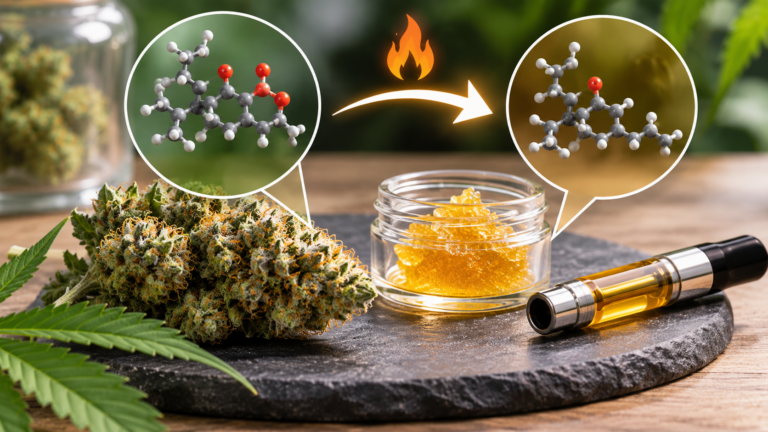
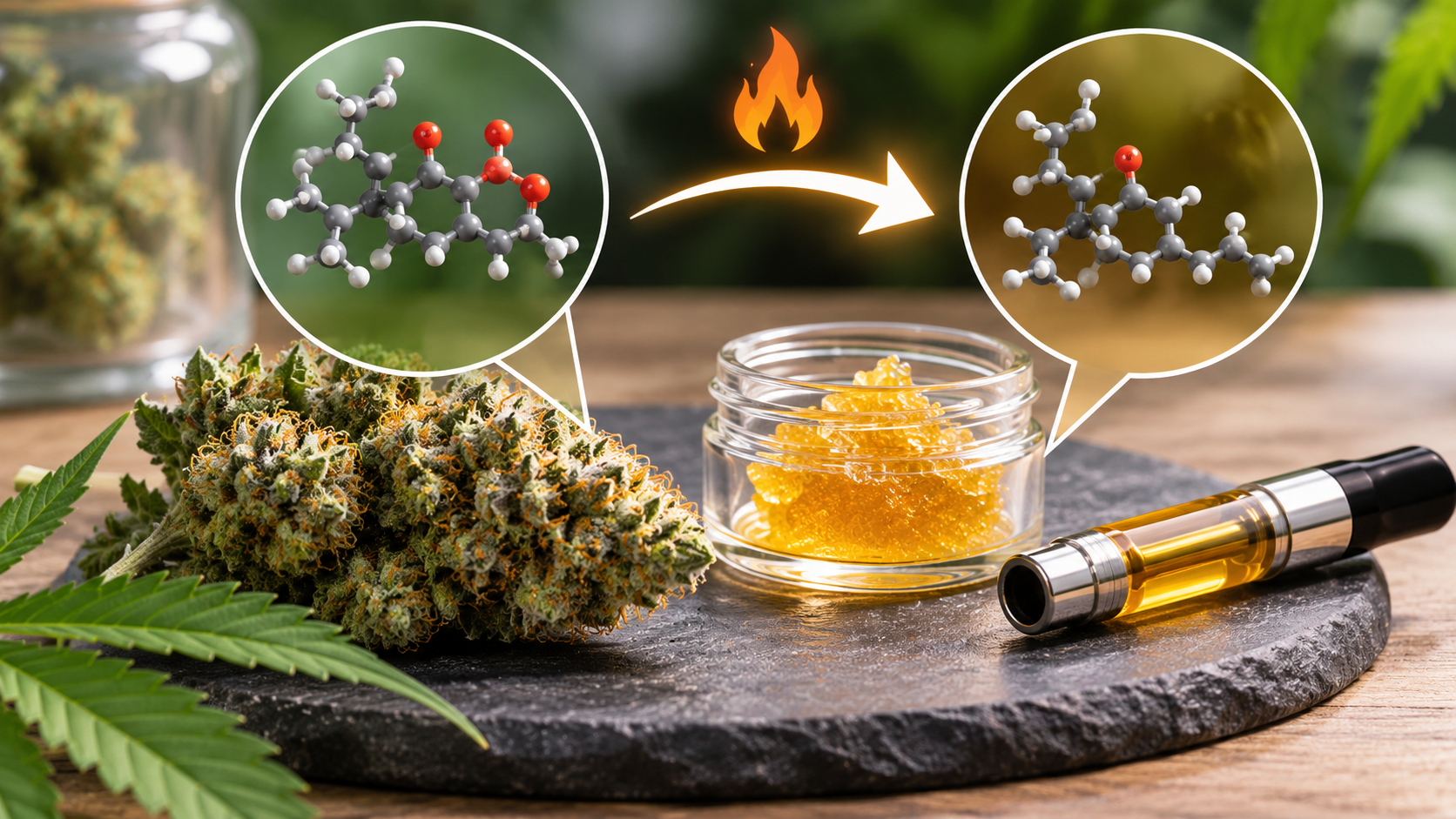
The chemical process is called decarboxylation. THCA has a carboxyl group that can be lost as carbon dioxide, leaving the neutral THC molecule. Heat can accelerate this change, which is why cannabis heated through common consumption methods can be intoxicating even when its original laboratory report showed mostly THCA. Some conversion can also occur during processing or storage. [5]
present in the plant
during chemical change
may be produced
This is where two common misunderstandings begin. First, the process is not guaranteed to be complete. Second, the familiar 0.877 number is not a real-world heating efficiency rate. It reflects a difference in molecular weight, because the molecule loses carbon dioxide when THCA becomes THC. Laboratory researchers have also shown that testing techniques can introduce measurement biases if conversion and analysis are not handled carefully. [5][6]
The formula estimates chemical potential, not how much THC someone absorbs. “THCA is THC” and “THCA can never cause a high” both miss the important role of heating.
What does “Total THC” mean? Understanding the 0.877 formula
For a simplified example involving just delta-9 THCA and delta-9 THC, a standard potential-total-THC calculation is delta-9 THC + (THCA × 0.877). The 0.877 factor accounts for the difference in molecular mass between the acidic and neutral forms. You must use matching concentration units on both sides of the calculation. [1][6]
California's complete regulatory definition can include delta-8 THC and its acidic form as well. This shorter formula is useful for reading our two-component example; it is not a replacement for the full laboratory calculation when other relevant cannabinoids are present. The report and applicable product rules determine what is actually being declared. [1]
A hypothetical flower-label calculation
Imagine a fictional flower sample with 24.00% THCA and 1.00% delta-9 THC. For this example, assume no other THC forms need to be included. We're using easy numbers to explain the mathematics. These are not results from a High Society product or a real certificate of analysis.
Example laboratory panel — illustration only
Math: (24.00 × 0.877) + 1.00 = 22.048%. For material measured by mass, 1% = 10 mg/g, so 22.048% corresponds to 220.48 mg/g of potential total delta-9 THC in this fictional sample. This is a concentration conversion, not an absorbed dose. No actual COA or batch ID is represented.
Notice why 24% THCA plus 1% THC does not equal 25% potential THC: molecular mass changes. The calculated 22.05% also cannot tell you what someone absorbs or how impaired they might feel. And total cannabinoids is a separate laboratory summary that may include CBD, CBG and other cannabinoids; it isn't another name for total THC.
How to read a California cannabis label without guessing
Labels and certificates of analysis (COAs) describe chemistry and traceability, not guaranteed effects. California's cannabinoid-content labeling rule calls for Total THC as a percentage for nonmanufactured cannabis. Edibles and concentrates with established servings use milligrams per serving and package; other product types have their own rules. A complete COA may show much more than the package. [1][7]
| Label field | Useful meaning | What it doesn't prove |
|---|---|---|
| THCA | Measured acidic cannabinoid content in the sample | How much THC will actually reach a person |
| Delta-9 THC | Measured neutral delta-9 THC content | Precisely how intense or long the effects will be |
| Total THC | Regulated calculation combining relevant THC forms | That every molecule converts during use |
| THC per serving | Declared amount in a manufactured serving when applicable | Uniform effects across individuals |
| Batch / COA | Traceability to the relevant laboratory report | A guarantee that different batches are identical |
Swipe sideways to read the full table on a small screen.
- Match the batch: does the package or listing identify the same batch as the report?
- Find the method and units: percentage, mg/g and mg per serving are not interchangeable without a calculation.
- Locate both cannabinoids: look separately for THCA and delta-9 THC when reported.
- Read the calculated total: check whether the lab includes other THC forms under its definition.
- Check reporting limits: “ND” (not detected) or “<LOQ” does not mean absolutely zero.
This is an educational checklist, not an authentication of any specific laboratory report. A certificate only supports the sample and batch it actually identifies.
A flower percentage cannot be compared directly with an edible's milligrams per serving. Neither number predicts exactly what someone will feel.
A 2025 study of 277 Colorado flower and concentrate products found more THC-label discrepancies in flower than concentrates. It does not establish the accuracy of any current California batch. Check the relevant COA rather than treating an advertised figure as exact. Our liquid diamonds vs live resin guide explains more extract and label terminology. [6]
Where you see THCA and THC across High Society's product formats
We write for Orange County readers because these numbers appear in more than one part of a cannabis menu. You'll see THCA in discussions about flower, THC on many manufactured cannabis labels, and both terms in detailed laboratory results. The product format and the cannabinoid measurement tell you different things.
| Product format | What to look at | Important distinction |
|---|---|---|
| Cannabis flower | THCA, delta-9 THC and total THC, where reported | Variety name alone doesn't tell you the tested chemistry |
| CBX flower terminology | Brand, cultivar description and relevant batch label | A catalogue example is not independent lab verification |
| Vape cartridges and pods | Oil formulation, THC amounts and compatible hardware | An oil's profile is not defined by a flower label alone |
| Raw Garden cartridge example | Product format and batch-specific cannabinoid declarations | The listing doesn't establish today's test figures |
| Concentrates | Extract type and cannabinoid profile | Extract marketing names don't replace lab measurements |
| Edibles | Milligrams per serving and per package | Serving amounts should not be read as flower percentages |
Swipe sideways to read all columns.
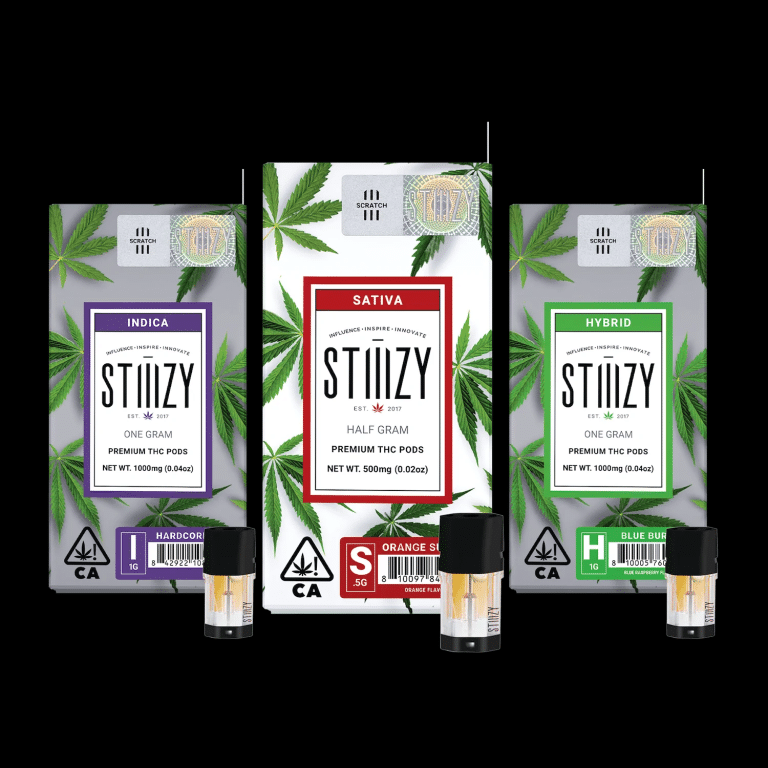
We link to formats you can identify on our site, not to imply specific stock, prices, lab results or effects. Our vape hardware explainer helps with cartridges versus pods; STIIIZY pods are one example of the pod format, not evidence of any particular batch's potency.
Start with the flower category when you want to understand flower labels. For a comparison with manufactured serving units, look at the edibles category. Treat catalogue descriptions as a starting point, then refer to the actual package and applicable batch information rather than assuming two products share the same test values.
For Orange County readers, understanding what a label says—and leaves out—is more useful than another unexplained potency claim.
Is THCA legal in 2026? Why blanket answers are misleading
Regulatory context checked November 23, 2026. Laws and effective dates may change.
A chemical name does not establish that a product is legally classified as hemp, that it is lawful in every state, or that it can cross state lines. Definitions can depend on the plant material, total THC measurements, product type, intended use, the jurisdiction and the effective date of applicable law. “It's THCA, not THC” is not enough to settle any of those questions.
There are two important 2026 dates. Under a delayed federal hemp-definition amendment, an exclusion addressing certain hemp-derived products containing cannabinoids not capable of being naturally produced by the plant took effect November 12, 2026. Most remaining changes are scheduled for December 11, 2026; those changes include counting THCA in a total-THC definition. These are statutory changes, not an automatic verdict about every product. [8]
California cannabis retail and hemp rules are distinct and can change independently. We don't translate that complexity into a one-line “THCA is legal” claim. For a specific product or destination, confirm the rules currently in force. This article is educational, not legal advice.
THCA, THC and safety: what numbers cannot tell you
THC can impair judgment, reaction time and coordination. Products described as THCA-rich may still be intoxicating when heated because of conversion. For that reason, the word “THCA” should not be interpreted as a universal safety claim. Avoid driving or operating machinery after cannabis exposure, and do not rely on a THC percentage, a calculation or how alert you feel to decide that impairment has ended. [2]
Unwanted effects can include anxiety, dizziness, rapid heartbeat, confusion and problems with coordination. People respond differently, and combining cannabis with alcohol or other substances adds uncertainty. Keep cannabis products securely away from children and pets. If a person has severe symptoms, trouble breathing, chest pain, seizures or becomes difficult to wake, seek emergency medical assistance; do not wait for a label calculation to provide an answer.
People taking medications, those who are pregnant, and those managing medical conditions should seek personalized advice from an appropriate healthcare professional. Early laboratory findings about acidic cannabinoids should not be read as proof that THCA treats a disease. Our guide to cannabis-effect duration and impairment explains why feeling different and being functionally unimpaired are not the same thing.
THCA vs THC: frequently asked questions
1. Is THCA the same thing as THC?
No. THCA is an acidic precursor and delta-9 THC is the neutral intoxicating cannabinoid. THCA can change into THC through decarboxylation, but the names should not be used interchangeably on a laboratory report.
2. Can THCA make you feel high?
Unheated THCA itself is not generally considered intoxicating like delta-9 THC. However, heating a THCA-containing cannabis product can convert some THCA into intoxicating THC. A “THCA” product description therefore does not guarantee non-intoxicating effects.
3. Why can flower have high THCA but low delta-9 THC?
The cannabis plant commonly contains substantial amounts of acidic cannabinoids before heating. A laboratory may measure that THCA separately from delta-9 THC, then calculate potential total THC using the appropriate formula.
4. What does the 0.877 conversion factor mean?
It accounts for the change in molecular mass when THCA loses carbon dioxide as it becomes THC. It is not a prediction that exactly 87.7% of the THCA will convert during real-world use.
5. How do I calculate potential total THC from a label?
For a simple sample containing only delta-9 THCA and delta-9 THC, multiply the THCA percentage by 0.877, then add the delta-9 THC percentage. More complete regulatory calculations can include other relevant THC forms, and the units must match.
6. Does higher total THC mean a product is always stronger?
No. Total THC describes potential cannabinoid content, not the full experience. Product formulation, individual variability, route of exposure and other factors matter. A higher figure does not guarantee a particular effect or medical benefit.
7. Is raw THCA scientifically proven to treat medical conditions?
No established consumer treatment claim follows from the available early-stage research. Laboratory and animal studies are not substitutes for controlled human trials. Avoid treating preliminary findings as medical proof.
8. Is THCA legal because it is different from delta-9 THC?
Not automatically. Legal definitions differ by jurisdiction and product category, and the federal hemp definition is changing in December 2026. The chemical difference does not by itself determine legality.
9. Are total THC and THC per serving the same number?
Not necessarily. Total THC can express concentration or a reported amount, while milligrams per serving describe the amount assigned to one serving of a manufactured product. Always read the label's units and relevant headings.
10. Can a THC or THCA percentage show when it is safe to drive?
No. Laboratory potency numbers and subjective feelings do not provide a personalized assessment of driving fitness. THC can impair attention, reaction time and coordination, and the safest choice is not to drive after cannabis exposure.
The takeaway from High Society
THCA vs THC sounds like a complicated chemistry debate until you look at the label. THCA describes an acidic cannabinoid in cannabis. Delta-9 THC describes a related intoxicating compound. Potential total THC is a calculated figure that helps express their relationship, and the 0.877 multiplier explains the molecular-weight adjustment—not a guaranteed result for an individual.
Our advice: read the units, check the right batch, and remember that chemistry and effects are different questions. No brand name replaces that context.
Research notes and references
Source review date: November 23, 2026. We relied on primary laboratory, chemistry and regulatory material where accessible, plus a contemporary scientific review for context. The simplified fictional label is original teaching material; it is not a lab test, medical review or legal determination. The page has not been independently clinically or legally reviewed.
- California cannabinoid testing regulation, section 15724.
- 2026 scientific review: THC and cannabis-related driving impairment.
- 2026 scientific review: chemistry, pharmacology and limitations of acidic cannabinoid research.
- Experimental receptor study: THCA-A affinity and efficacy at cannabinoid receptors.
- 2025 analytical chemistry paper: THCA decarboxylation and total THC measurement.
- 2025 original study: labeled THC potency in flower and concentrate products.
- California manufactured and nonmanufactured labeling guidance and California definition of Total THC, section 15700.
- October 2026 legal analysis: November 12 and December 11 hemp amendment dates.