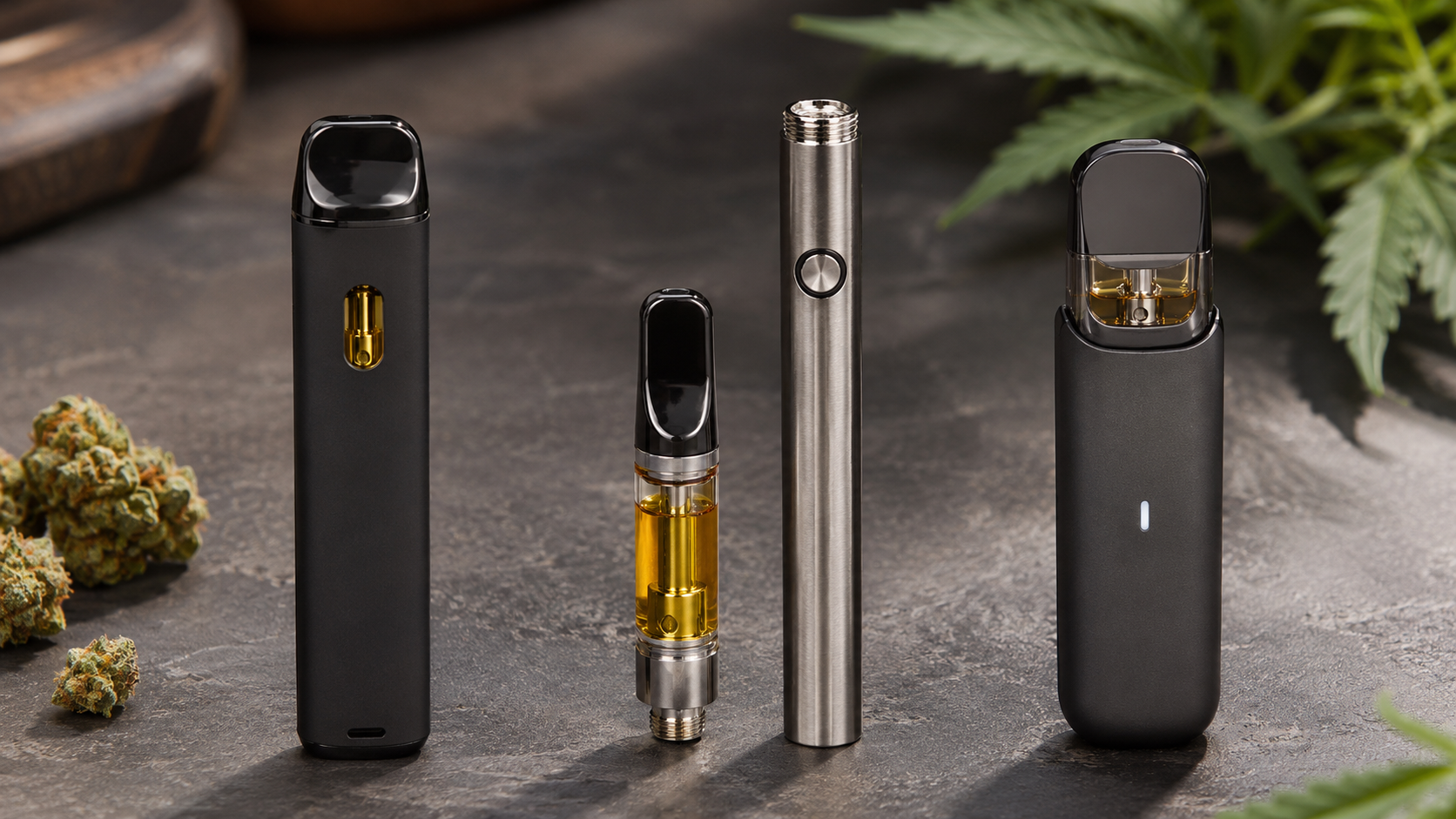
A weed cartridge, a proprietary pod and an integrated vape can all hold cannabis oil. The difference is the hardware around that oil. A 510-thread cart connects to a separate compatible battery; a pod fits a specified battery system; and an all-in-one keeps the battery and oil chamber together. That answers the main question—but the battery model, product label and end-of-life rules are where the details matter.
At High Society, we start with what connects, what gets replaced, and what the label confirms. No guesses about stock, prices or potency.
Weed Cart vs All-in-One Vape vs Pod: Quick Comparison
Here's the easiest way to remember the three categories: a cartridge is a replaceable oil container that uses a separate battery; a pod is also replaceable but normally belongs to a specific system; and an all-in-one is an integrated device. None of these names, by itself, tells you whether the oil is distillate, live resin, or another formulation.
| Feature | 510-thread cart | Proprietary pod | All-in-one vape |
|---|---|---|---|
| Battery arrangement | Separate rechargeable battery | Separate system-specific battery | Battery built into device |
| Oil chamber | Removable cartridge | Removable pod | Integrated with the device |
| Connection | 510 threaded, if stated | Brand/model-specific fit | No external cartridge connection |
| When oil is depleted | Keep battery; replace cart | Keep battery; replace compatible pod | Device reaches end of usable life |
| Charging | Depends on battery | Depends on battery model | Some rechargeable, some not |
| Major thing to verify | Connector and electrical fit | Exact pod/battery generation | Whether it is integrated and its charging instructions |
“Disposable vape” is common search language. In California, cannabis cartridges and integrated devices are not regular-trash disposables; the required hazardous-waste notices appear below.
Cartridge + separate batteryTwo pieces connected by compatible threading
Pod + matched batteryA fit designed for a specified system
One integrated unitOil chamber and battery housed together
What Is a 510-Thread Weed Cartridge?
A 510-thread cartridge is a replaceable oil container that connects to a battery with a common screw-thread format. The cartridge holds the oil and heating component; the separate battery provides power. When the cartridge is finished, the battery can be retained for a compatible replacement. That's the main practical benefit of modular hardware.
Many people call these “weed carts” or “THC carts.” Just remember that 510 describes the connection, not the oil inside. A 510 cartridge might contain distillate or a different extract. You need the actual product description and label to know which.
Does every 510 cart work with every 510 battery?
No—not automatically. Matching threading is an important first step, but cartridge width, contact design, the battery's voltage range, device clearance, and manufacturer guidance still matter. Batteries with concealed cartridge chambers can be especially restrictive about physical dimensions. If the connector is correct but the cartridge does not seat properly, forcing it is not the answer.
High Society's Raw Garden cartridge page provides a real-world example of the cartridge category. The manufacturer identifies its cartridges as 510-threaded, but readers should still verify the particular cartridge and battery model rather than assume every combination works perfectly.
Why do reusable batteries matter?
The hardware stays with you when the oil chamber is replaced, which separates a longer-lived electronic component from the individual cartridge. Some batteries offer adjustable power settings; others use one preset. More settings do not necessarily mean a better device, and higher voltage is not proof of better oil. Follow the exact battery and cartridge instructions, especially where a manufacturer specifies a recommended setting.
How Are Proprietary Vape Pods Different?
A pod performs a similar job to a cartridge, but instead of relying on 510 threading, it usually uses a system-specific shape, contacts, and locking design. It may snap or slide into the battery. That makes the hardware look tidy, but it also means a pod from one line generally won't fit another line's battery.
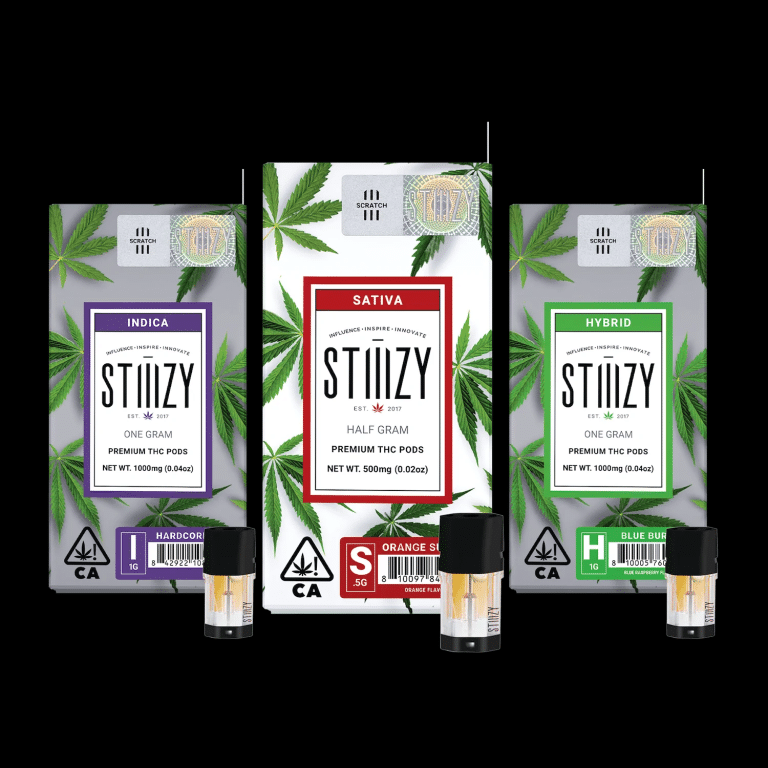
STIIIZY and PLUGPLAY are two useful examples because both appear on High Society's menu. STIIIZY pods use STIIIZY-specific hardware, while PLUGPLAY pods require compatible PLUGPLAY hardware. They're not simply different flavors of a universal 510 cart.
There is one more detail worth checking: compatibility can change between generations within a brand. A familiar brand name on the battery is not always enough. Read the model identifier and any notices on the pod package. A retailer page might show a product family while the physical package carries the decisive model information.
What Is an All-in-One, Often Called a Disposable Weed Vape?
An all-in-one, or integrated cannabis vaporizer, packages the oil container, heating element and battery into one unit. It doesn't need a separate 510 battery or a pod starter kit. That's why these devices are often grouped under the casual term “disposables,” even though the word should never be taken to mean they're safe to throw away.
High Society has a DIME all-in-one listing that illustrates this format. The public listing establishes the product category, but it doesn't justify claims about every batch, the device's actual charging port, or whether a particular variation is currently in stock. Those details must come from the exact item and its instructions.
Are all-in-one vapes rechargeable?
Some are, and some are not. “All-in-one” means integrated hardware, not necessarily a non-rechargeable battery. A USB charging port may help keep an integrated device functioning while the oil remains, but a charging port does not make the oil chamber replaceable. Follow the actual model's guidance, never modify the device, and don't assume another charging cable or adapter is approved simply because it fits.
What happens when the oil runs out?
The integrated oil chamber is generally not replaceable. A finished unit may contain residual cannabis and electronics; California requires appropriate hazardous-waste collection, not household trash.
Battery Compatibility: What Fits What?
Before comparing extract names, verify the connector and the exact battery model. A pod family can change between generations, and 510 threading alone cannot guarantee a cartridge physically clears the battery housing or works within the maker’s electrical limits.
| Product type | 510-thread battery | STIIIZY battery | PLUGPLAY battery | Extra note |
|---|---|---|---|---|
| Verified 510-thread cartridge | Usually, if mechanically and electrically compatible | Not as a standard STIIIZY pod | Not as a standard PLUGPLAY plug | Check cartridge size and manufacturer limits |
| STIIIZY proprietary pod | No standard 510 fit | Check exact pod and battery generation | No | Product generation matters |
| PLUGPLAY proprietary plug | No standard 510 fit | No | Only with an approved model | Check regional and model details |
| Integrated all-in-one | Not applicable | Not applicable | Not applicable | Battery and chamber are already combined |
- Check the product category: is it marked 510-thread, a named proprietary pod, or integrated all-in-one?
- Check the exact battery model: matching a brand logo is not enough when generations differ.
- Check physical and electrical limits: clearance, connector contacts, and the maker’s voltage guidance all matter.
- Stop at uncertainty: do not force a cartridge, use improvised adapters, or assume cross-brand compatibility.
Look for a verified 510 cartridge and check the battery’s size and voltage guidance. The connector label is only the first check.
Match the exact pod line and generation. A familiar brand name does not guarantee older and newer hardware work together.
It may be an integrated all-in-one. Verify the actual package; a charging port does not make its oil chamber removable.
Which Format Costs More Over Time?
A shelf price alone is misleading. Compare equivalent labeled oil quantities, the separate battery (if required), and the number of replacement units over the same period. Prices change, so this is a framework rather than an invented price ranking.
| Cost question | 510 cartridge | Proprietary pod | All-in-one |
|---|---|---|---|
| Initial setup | Cartridge plus compatible battery, unless one is already owned | Pod plus matching battery, unless one is already owned | Integrated device |
| Next oil purchase | New cartridge, battery retained if functional | New matching pod, battery retained if functional | Another integrated device |
| Ongoing consideration | Battery longevity and replacement cart availability | Dependence on one pod ecosystem | New electronics with each integrated unit |
| Fair comparison | Compare total cost for similar labeled oil quantities and equivalent time periods; use actual current menu information | ||
How to make a fair cost comparison
Start with the actual battery price, if there is one, then add the current prices of comparable cartridges, pods or integrated devices. Use consistent units, include applicable taxes and fees, and separate net oil weight from labeled THC milligrams. A product name containing “1000mg” does not by itself establish 1000mg of THC.
For a reusable setup: include the battery once, plus the replacement cartridges or pods in the period. For an all-in-one format: include each full integrated unit. This is arithmetic, not a price or performance claim.
Does Cart, Pod or All-in-One Tell You What's Inside?
No. Hardware format is one decision; oil formulation is another. People often mix them up because a product page or package may put an extract label and hardware name right next to one another. “Live resin pod” tells you more than “pod,” but it still doesn't tell you everything about the actual batch.
Distillate, live resin and liquid-diamonds terminology
Distillate generally refers to a refined cannabinoid-rich extract. Live resin is associated with fresh-frozen source material and a particular extraction history. “Liquid diamonds” is used for different commercial formulations, so the name alone does not establish a universally consistent recipe. Each can appear in more than one type of vape device depending on the manufacturer's design.
The important point is that a 510 cart isn't automatically live resin, and an all-in-one isn't automatically distillate. Read the producer's product description and the physical label. If a marketing name makes a claim the label can't confirm, look for separate reliable documentation.
Can you tell how powerful a device is from its battery size?
Not from mAh alone. Battery capacity describes charge storage, while voltage and other electrical characteristics relate to power delivery. Neither figure establishes a given THC experience. Comparing a device's battery capacity to a product's THC percentage mixes two different measurements, and neither replaces instructions for the actual hardware.
What California Vape Labels Can Tell You
The physical California package tells you more than a product thumbnail. Look for the manufacturer, packaging date, batch or lot number, UID or tracking identifier, declared ingredients and cannabinoid amount. For cartridges and integrated vaporizers, the universal cannabis symbol also has a specified minimum size on the product itself.
A batch identifier helps connect a product to regulatory test information for that batch. A QR code may point to information, but cannot by itself prove authenticity or safety.
Verify on the package: product identity, manufacturer, package date, batch number, tracking identifier, ingredient list, labeled cannabinoids and warning information.
Confirm separately: exact battery fit, any model-specific charging instructions, live availability, a product’s manufacturing method and batch-linked testing evidence.
Do not assume: a QR code alone proves authenticity, a high THC percentage proves quality, or a cannabis symbol means the product has no health risk.
Why the California cannabis symbol matters
The California universal cannabis symbol is required on regulated packaging, with additional size rules for cartridges and integrated vaporizers themselves. It's one element of a broader labeling system—not a guarantee of authenticity or safety when viewed in isolation. A missing or mismatched label detail is a good reason to stop and verify the product rather than make assumptions.
You can find the underlying rules in the California manufactured-product labeling checklist and the current regulation text. We use these references to keep legal statements grounded rather than guess about requirements.
California Disposal Rules: Why “Disposable” Is Misleading
Here's a detail worth knowing before you finish any cartridge or integrated device. Even though people commonly search for “disposable weed vapes,” California rules require cannabis cartridges and integrated vaporizers to be handled as hazardous waste. Used batteries and residual contents are not ordinary household trash, and they do not belong in a standard curbside recycling bin.
A spent cannabis cartridge shall be properly disposed of as hazardous waste at a household hazardous waste facility or other approved facility
An empty integrated cannabis vaporizer shall be properly disposed of as hazardous waste at a household hazardous waste collection facility or other approved facility.
See the California vape disposal and marketing requirements for the source wording.
Never puncture a battery, pour out oil, attempt to refill a sealed product, or put an integrated vaporizer into a household recycling stream. Find a properly approved collection facility and follow its acceptance instructions. This is one area where the convenient product nickname can be seriously misleading.
High Society's Orange County Hardware Examples
Our vape, pod and battery category provides examples of the three hardware families. A Raw Garden cartridge listing illustrates 510-thread carts; STIIIZY pods and PLUGPLAY plugs illustrate separate pod ecosystems; and a DIME integrated-device page illustrates all-in-one hardware.
If you're comparing the two pod families, our STIIIZY vs PLUGPLAY explainer covers that question in more detail. These links are for product context only; don't treat their names, prices or listed variants as live inventory or proof of specifications for every model.
High Society delivers across Orange County, including Irvine, Newport Beach, Laguna Beach, Dana Point and San Clemente.
FAQs: Weed Carts, Pod Batteries and All-in-Ones
Is a weed cart the same as a disposable vape?
No. A cart is usually a removable oil cartridge that needs a separate compatible battery. An all-in-one includes its own battery and oil chamber in a single device. Both require proper hazardous-waste disposal after use.
Is a 510-thread cartridge the same as a pod?
Not usually. A 510 cart uses a common threaded connector; a proprietary pod uses a connection designed for a particular battery family. Check the exact model instead of judging by appearance.
Can I put a STIIIZY pod on a 510 battery?
A normal STIIIZY proprietary pod is not designed as a standard 510-thread cart. Check the specific STIIIZY battery and pod generation for approved compatibility.
Will a PLUGPLAY pod fit a STIIIZY battery?
No standard cross-compatibility should be assumed. The brands use different proprietary systems. Use the battery family specified for the product.
Can an all-in-one have a charging port?
Yes. Some integrated devices are rechargeable, but that does not mean their oil chambers can be replaced or refilled. The product's own instructions determine charging and end-of-life handling.
Does a more expensive battery make stronger THC oil?
No. A battery's specifications and an oil's measured cannabinoid content are different things. Hardware choice does not change the labeled THC content in the oil.
Are all 510 cartridges compatible?
No universal guarantee exists. Matching threading helps, but dimensions, electrical limits and the maker's guidance also matter. Don't force or modify an incompatible product.
Which format creates more electronic waste?
An integrated unit includes electronics with every oil chamber, while cartridges and pods use a longer-lived battery when it remains functional. That difference alone does not quantify environmental impact; materials, product lifespan and proper hazardous-waste collection also matter.
Can a QR code prove a vape is safe?
No. A code may help locate information, but it cannot independently establish product safety, batch authenticity or manufacturing history. Check the manufacturer details, label and relevant batch documentation.
A Final Note on Health and Product Information
Vaping cannabis is not risk-free. Public-health guidance associates cannabis vaping with lung injury and cautions that concentrated oils may have additional health risks. This article is a comparison of hardware and labeling, not medical advice, a product safety certification, or instructions to use cannabis. Keep cannabis products away from children, and follow applicable age and local requirements.
We have not tested these devices or reviewed their batch reports. Follow current manufacturer instructions and physical labels.
Sources and How This Guide Was Checked
We checked California product-label and cartridge-disposal guidance, public-health information and the High Society links used as format examples. Manufacturer documentation informed our general distinction between 510 hardware and proprietary systems. We have not independently tested hardware, examined a particular batch COA or confirmed live inventory.
- California manufactured-product labeling checklist — package information, cannabis symbol and identification.
- California vape disposal and marketing requirements — hazardous-waste messaging.
- California cannabis regulation text — current legal definitions and product rules.
- Public-health cannabis FAQ — health-risk background.