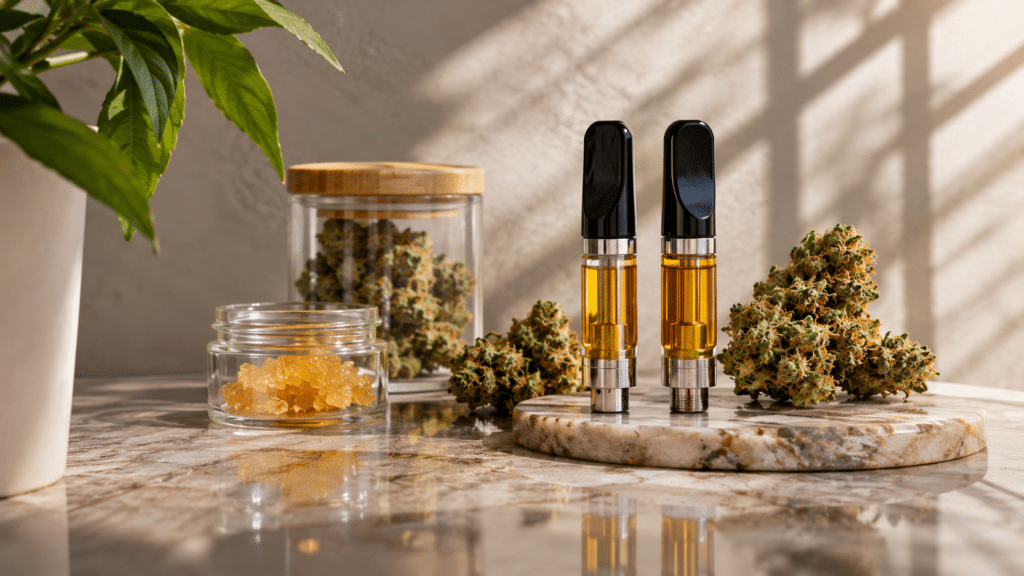
Live resin carts generally use cannabis extract made from plant material frozen soon after harvest, while distillate carts use a more extensively refined cannabinoid oil. The useful choice depends on the actual ingredients, terpene information, oil amount and product label, not on a blanket claim that either type is always better.
We know these names can get confusing when you’re looking at two vape carts. They both contain cannabis-derived oil, but the terms describe different parts of how that oil came together. At High Society, we prefer to make the comparison practical: what does the label mean, what can you compare side by side, and what should you ask when the description is vague?
Below we’ll compare the oils, explain why terpene language varies, work through a simple THC-label example and show how to read the details before exploring the vape menu. This is a guide to oil formulations, not a guide to battery connections or hardware troubleshooting.
What’s the difference between live resin and distillate carts?
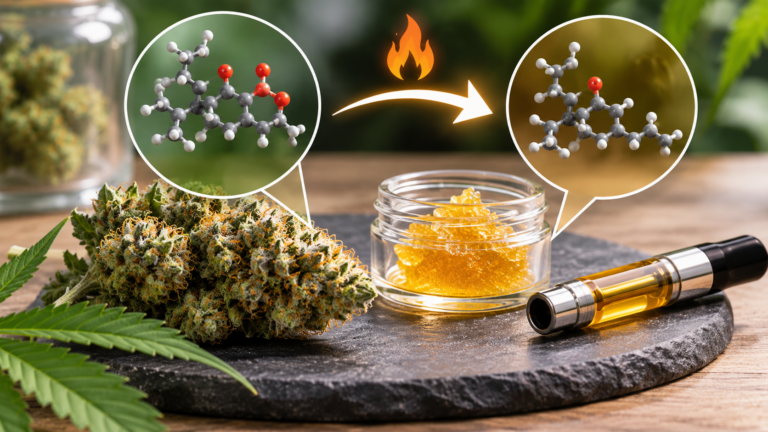
Live resin refers to an extract associated with cannabis that was frozen soon after harvest, before the usual extended drying and curing process. Distillate describes a cannabinoid ingredient that has gone through further refinement and separation. Both may be used in finished vape-oil formulations, which means a name on its own doesn’t describe every ingredient inside a cart.
| What you’re comparing | Live resin | Distillate |
|---|---|---|
| The term describes | Source-material handling and an extract associated with that process | A more refined cannabinoid fraction |
| Typical starting material | Cannabis frozen soon after harvest | Cannabis extract, which can come from various starting materials |
| Further processing | Extraction and preparation for the finished formulation | Additional distillation and separation before formulation |
| Aromatic ingredients | May carry compounds associated with the starting material; the finished blend can still vary | Terpenes or other disclosed ingredients may be added after refinement |
| THC concentration | Varies by individual product and batch | Varies by individual product and batch |
| Best way to compare | Read the actual product formulation and batch information | Read the actual product formulation and batch information |
On a narrow screen, swipe sideways within the table to see every column.
The key is to compare finished oils, not just category names. A live-resin cart may be described using the original extract and its terpene profile. A distillate cart might explain the terpene source separately. Those are different descriptions, and neither one tells you a complete recipe without more information.
How are live resin and distillate oils made?
The first major difference is what happens to the cannabis before and during extraction. Live resin usually starts with material that was frozen shortly after harvest. That choice is associated with preserving features of the starting plant, particularly volatile aromatic compounds that might otherwise change during handling and processing.
Distillate takes a different route. A producer first obtains a cannabinoid-containing extract, then uses additional separation and refinement to concentrate particular compounds. A finished cart can later be formulated with additional ingredients, including terpenes. That is why the phrase “distillate cart” doesn’t automatically mean that the finished oil has no aroma-related ingredients.
These are simplified pathways, not manufacturing instructions. Real products may involve multiple refinement stages, blends or ingredient sources. A phrase such as “refined live resin” can describe additional processing of a frozen-source extract; it should not automatically be translated into either “ordinary distillate” or “unrefined oil.” When the wording matters, the producer’s description is more useful than guessing from the name.
What do terpenes tell you about live resin and distillate?
Terpenes are aromatic compounds that occur in cannabis and many other plants. They contribute to scents commonly described as citrusy, pine-like, herbal or earthy. In a vape-oil description, the important question is often not just whether terpenes are present, but where they came from and whether the manufacturer describes adding them during formulation.
A live-resin process is commonly discussed in connection with retaining compounds from the frozen starting material. That doesn’t guarantee that every finished live-resin cart will have the same terpene content or a particular aroma. Extraction, further processing and formulation all make a difference. The description on the finished product matters more than a general assumption about the category.
Distillate formulations can also include terpenes. Some products describe cannabis-derived terpenes, while others use terms such as botanically derived terpenes. Both descriptions concern ingredient sourcing; they do not, by themselves, identify the exact concentration of each terpene in the finished oil. A listed compound such as limonene may be measured in different plant extracts, so its presence does not prove that a formulation was made from fresh-frozen cannabis.
Does “full spectrum” tell you exactly what’s in a cart?
No. “Full spectrum” is a broad product-description phrase, not a universal ingredient list. Two products using that wording might still differ in which cannabinoids and aromatic compounds are present. When you’re comparing, look for a clear oil description and any available ingredient information instead of treating one phrase as a complete chemical profile.
Can a terpene test confirm the origin of live resin?
A terpene analysis can identify certain compounds in the tested sample and sometimes their reported amounts. It generally cannot tell you when a cannabis plant was harvested, how quickly it was frozen or which production steps a manufacturer used. For that history, look for the producer’s actual sourcing and process description.
Does distillate always contain more THC than live resin?
No. Refining can produce a cannabinoid-rich distillate ingredient, but a finished distillate cart is not guaranteed to have more THC than every finished live-resin cart. The right comparison is between the actual percentages or amounts displayed for the individual products, using the same measurement units.
You may notice one label advertising a THC percentage while another lists an amount in milligrams. Those figures are related but cannot be compared without accounting for the amount of oil in each cartridge. A percentage describes concentration; a milligram amount describes mass. Neither one tells you what other ingredients make up the rest of the oil.
Example: What does 75% THC mean in a 1-gram cart?A 1-gram cartridge contains approximately 1,000 mg of oil. If that oil is 75% THC by mass, the simple calculation is:
1,000 mg of oil × 0.75 = 750 mg THCThese are hypothetical numbers for explaining label math, not figures from a High Society product or laboratory report.
Now imagine a half-gram cart with an 82% THC concentration. In the same simplified calculation, its 500 mg of oil would contain about 410 mg of THC. The half-gram cart has a higher percentage, yet the one-gram example has a larger total calculated THC amount. That’s a useful reason to check both oil weight and percentage before comparing two listings.
How can you read a vape-cart label without guessing?
Start with the exact item you’re comparing, then look at its oil weight, cannabinoid information and ingredient wording. If a manufacturer makes a specific sourcing claim, try to find the corresponding explanation rather than expecting a single THC percentage to confirm it.
- Match the product. Check the exact product name, size and any batch identifier. If a laboratory report is supplied, it should refer to the relevant item or batch.
- Match the units. Compare percentages with percentages, or convert measurements carefully when you’re looking at milligrams and total oil weight. A one-gram cart is not the same as one gram of THC.
- Separate ingredient statements from measured values. THC and terpene figures describe the tested sample. Words like “fresh frozen,” “refined” or “cannabis-derived terpenes” describe a sourcing or processing claim and may require producer information to clarify.
- Read the full formulation description. Oils can contain additional components. “Live resin,” “distillate” and “with added terpenes” may refer to different elements of the same finished formulation.
If no batch-level results are available in a listing, don’t fill in the blanks with assumptions. The useful takeaway is simply that some details are known, while others have not been shown. This avoids turning a category label into a claim about exact chemical composition.
Which type of cart makes more sense for your priorities?
Rather than declaring one universal winner, we find it more useful to start with the details a reader wants to compare. Someone interested in how the extract was made may look for a clear account of the source material. Someone comparing cannabinoid concentrations will need consistent numbers. Someone interested in aromatic ingredients can look for terpene sourcing and composition details.
Is the source of the oil your main question?
Focus on what the producer says about the original cannabis and processing stages. “Live resin” commonly points to frozen starting material, while “distillate” describes further refinement. If a product uses both kinds of language, look for the explanation of how the finished blend was assembled instead of guessing that the terms conflict.
Are you comparing the ingredient list or terpene wording?
Pay attention to whether the description distinguishes the base oil from added components. Cannabis-derived and botanically derived terpenes are useful sourcing descriptions, but they aren’t the same as a complete formula. Clear ingredient wording can help you make a more direct comparison between products that otherwise look similar.
Are you mainly comparing reported THC amounts?
Use the actual concentration and oil size. When possible, compare the same cannabinoid measure and units on both packages. A simplified percentage calculation can help explain the figures, but the current product’s own label remains the relevant source for its contents.
Our view at High Society is simple: the better comparison is the one you can explain using actual information. A product name alone is rarely enough to answer every question about what’s in a cart.
How should you compare cartridge size and value?
Oil quantity is one useful starting point. A 0.5-gram cart contains half the oil mass of a 1-gram cart, so comparing only the listed prices can make products look more or less expensive than they really are. When current prices are available, dividing the price by oil weight produces a price-per-gram figure that can be compared across similarly packaged products.
That number is only a size-adjusted price comparison. It doesn’t establish which product has better ingredients, a particular extraction history or more detailed label information. Some formats also bundle hardware with the oil while others are cartridges designed for separate devices. If you’re comparing those formats, keep the hardware part separate from the oil-formulation question.
For the same reason, don’t confuse a cart’s capacity, its oil weight and the reported THC amount. They answer different questions. Reading those three details separately gives you a much more useful comparison than sorting products by one large number.
What are the most common questions about live resin and distillate carts?
Is live resin the same as live rosin?
No. Live resin commonly refers to extracts made from frozen cannabis using a solvent-based process. Live rosin is associated with mechanical separation and pressing of suitable starting material. The terms describe different approaches.
Can a distillate cart contain terpenes?
Yes. A finished distillate formulation can include terpenes added after refinement. The product description may identify them as cannabis-derived or botanically derived.
Does a high terpene percentage prove a cart is live resin?
No. Terpene measurements describe compounds in a sample, not the full history of the cannabis or how the oil was made.
Does a 1-gram cartridge contain 1,000 mg of THC?
Not necessarily. One gram is approximately 1,000 mg of total oil. The THC amount depends on the oil’s measured concentration and the units reported on the label.
Can a lab report prove that a cart uses fresh-frozen cannabis?
Not on its own. A report may describe measured cannabinoids and terpenes, but harvest timing and extraction history generally require information from the producer.
So what should you remember when comparing live resin and distillate?
Live resin usually describes an extract associated with cannabis frozen soon after harvest; distillate describes a more extensively refined cannabinoid ingredient. That difference matters, but the finished cartridge can still vary in oil composition, added terpenes, quantity and reported concentration. We recommend comparing the actual product details rather than picking a winner based on the name alone.
Want to compare vape formats in one place? High Society’s Vapes, Disposables & Batteries menu brings cartridge, disposable, pod and battery listings together. Use the product details to compare formats and descriptions without assuming all vape oils are formulated the same way.