


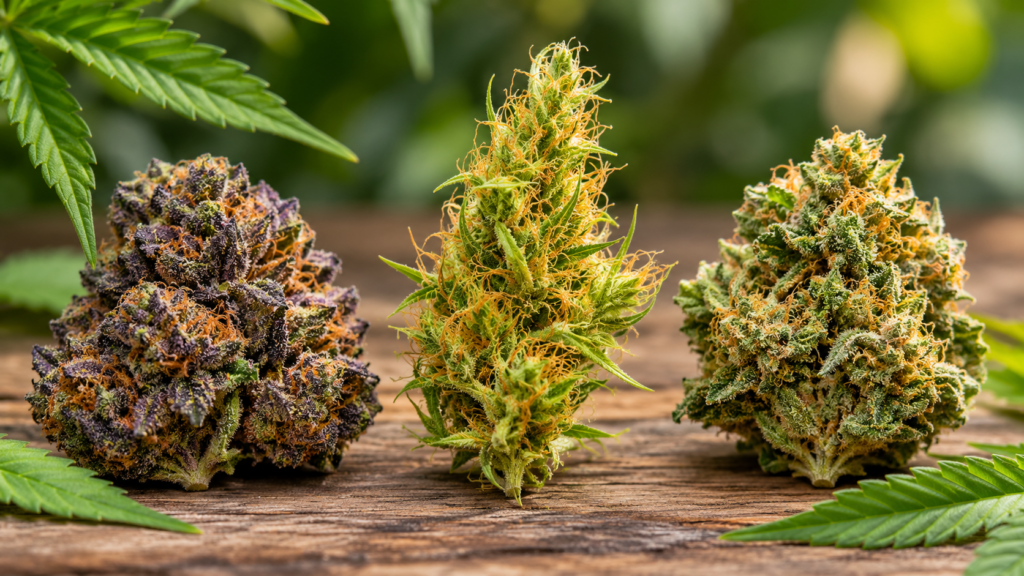
Indica vs sativa vs hybrid: what’s the difference? These three terms describe traditional cannabis classifications. Indica is commonly associated with relaxation, sativa with stimulation, and hybrid with a mix of characteristics. But those familiar associations aren’t scientific rules. None of the three labels can reliably tell you how much THC a product contains or how it will affect you.[1]
Here at High Society, we serve communities across Orange County, including Irvine, Tustin, Newport Beach, Laguna Beach and San Clemente. Let’s look at what these familiar cannabis terms mean and what the October 2026 research adds to the conversation.
Indica vs sativa vs hybrid: the differences at a glance
The main difference lies in the traditional plant descriptions, not a reliable difference in how someone will feel. Here’s a quick comparison.
Swipe or use arrow keys in the table to see all columns.
| Feature | Indica | Sativa | Hybrid |
|---|---|---|---|
| Historical plant description | Often shorter; broader leaflets | Often taller; narrower leaflets | Variable traits |
| Familiar association, not a guarantee | Relaxation | Stimulation | Mixed experiences |
| Fixed THC or CBD content? | No | No | No |
| Standard terpene profile? | No | No | No |
| Reliably predicts individual effects? | No | No | No |
These plant traits come from traditional botanical descriptions.[12] They aren’t reliable identifiers for every modern variety. Two plants with broad leaves can have very different chemistry, and those visual clues disappear when flower is processed into oil or edibles.
What do indica, sativa and hybrid mean?
What is indica?
Indica traditionally describes cannabis plants with a compact shape and broader leaflets. Over time, the word also became associated with calmness and sleepiness. You’ll hear that description quite often, but it’s not a rule. The name tells you neither that a product has more CBD or less THC nor that it has been shown to help with insomnia.
What is sativa?
Sativa traditionally refers to taller plants with narrower leaflets. In everyday cannabis terminology, people often associate it with stimulation. There’s another distinction worth knowing: scientists commonly use the botanical name Cannabis sativa even for plants that are commercially described as indica or hybrid. Botanical naming is still debated, so the familiar label on a package doesn’t settle the question.[12]
That’s why we don’t think of sativa as a promise of energy or a particular mood. The term doesn’t establish THC content or tell us whether someone with anxiety or another health concern will tolerate a product.
What is hybrid cannabis?
A hybrid is the offspring of genetically different parent lines. In cannabis descriptions, the word is often used more broadly for mixed ancestry or characteristics. It doesn’t mean there is an equal amount of THC and CBD, and it doesn’t mean someone will experience an exact middle ground between the effects traditionally associated with indica and sativa.
You may also come across terms like indica-dominant or sativa-dominant. These are familiar descriptions, not universally standardized measurements. Without genetic records, a percentage next to one of those words does not establish exact ancestry or tell you what percentage of an effect to expect.
Are indica and sativa really different? What the October 2026 research found
On October 24, 2026, the Journal of Cannabis Research published a systematic review by Gabriel Zoobi and colleagues examining whether commercial cannabis categories predict composition or outcomes. The review searched literature spanning June 2011 to June 2026.[1]
What stood out to us was how inconsistent the results were. Across the studies, the labels had limited agreement with measured chemistry. Some reports found links with particular aromatic compounds or certain human outcomes, but there wasn’t a dependable pattern that applied to all three categories.[1]
There’s a reason researchers are careful about those findings. If two groups report different experiences, the difference could come from THC exposure, the people involved or the way the study was conducted. Results from an animal study also cannot tell us how every person will respond.
The takeaway isn’t that all cannabis is the same. The review questions whether the names capture real chemical differences consistently. It also highlights insufficient evidence for predicting outcomes from terpene profiles. We reviewed its published abstract, but the full manuscript and study-level assessments were unavailable.
What genetics and chemistry can tell us
The new review builds on research that asked narrower questions about the plant itself. A 2021 Nature Plants study examined chemical measurements from 297 samples, including genetic data for 137 of them. Overall genetic and chemical patterns did not separate neatly along commercial classification lines. Some individual terpenes did show associations, including genetic variation linked to their production.[3]
A 2022 PLOS ONE study analyzed 89,923 commercial flower samples from six US states. Its relevant comparison of conventional labels used a smaller subset of 41,201 THC-dominant samples with suitable data. Their terpene profiles overlapped substantially across classifications. This was chemical analysis, not a clinical trial of human effects.[2] Earlier genetic work also found variation among samples sharing a commercial name.[4]
Swipe or use arrow keys in the table to see all columns.
| Evidence type | What it measures | What it does not establish by itself |
|---|---|---|
| Genetic analysis | DNA variation and relatedness | A person's response |
| Chemical testing | Compounds in a tested sample | Clinical benefit |
| Consumer survey | Reported experiences | Cause and effect independent of expectations |
| Controlled human research | Outcomes under specified conditions | Universal effects of all products with a label |
| Systematic review | Patterns and limitations across studies | Certainty beyond the quality of the underlying evidence |
A laboratory test can tell us what’s in a sample, not whether someone will sleep better. Human studies examine health outcomes, but their findings may apply only to the people and preparations studied.
THC and CBD are not synonyms for indica and sativa
THC (tetrahydrocannabinol) is responsible for much of the intoxicating effect of cannabis. CBD (cannabidiol) is another cannabinoid that generally does not produce the characteristic THC high. CBD can still affect the body and interact with medications. You can find varying amounts of these compounds across the traditional categories; their presence doesn’t establish safety or medical suitability.[5]
You might also hear the word chemotype. It refers to a group defined by chemical characteristics rather than a familiar strain name. Researchers describe THC-dominant, balanced THC/CBD and CBD-dominant samples, for example. These are descriptions of measured composition, not promises about how a person will feel.[2]
Terpenes: aroma chemistry, not guaranteed effects
Terpenes are aromatic compounds found in cannabis and many other plants. Myrcene, limonene and pinene are examples. They are part of the conversation about aroma and chemistry, but a familiar scent doesn’t establish that a product will improve sleep, concentration or anxiety.
Here’s what each of those three terpenes smells like and where else you’ll find it in nature:
- Myrcene: The most common terpene in today’s cannabis. It smells earthy, musky and herbal, with a sweet note often compared to ripe mango. You’ll also find it in hops, mangoes, lemongrass, thyme and bay leaves, and it’s used as a flavoring in food and drinks.
- Limonene: Named after the lemon, limonene is the main aroma compound in citrus peels and gives off a bright orange-and-lemon scent. It’s also found in rosemary, juniper and peppermint, and it’s what gives many cleaning products and cosmetics their citrus smell.
- Pinene: Smells like a pine forest. It’s one of the most common terpenes in nature and a main ingredient in turpentine, and it also turns up in pine needles, rosemary, basil, parsley and dill.
The entourage effect is the idea that different compounds may interact in the body. It’s an area of ongoing research, not a proven way to predict how someone will respond to a commercial terpene profile.[1] We explain another part of this terminology in our liquid diamonds vs live resin guide, where we separate extract names from chemical composition.
Indica, sativa and hybrid in different cannabis products
At High Society, these familiar terms appear across different cannabis formats, including our CBX (Cannabiotix) flower descriptions. A strain name and a product format tell you different things. Here’s a quick look at the distinction.
Swipe or use arrow keys to view the whole table.
| Format | What it is | What the name doesn’t tell you |
|---|---|---|
| Flower | Dried cannabis flower, often described by a cultivar or strain name. | Whether two varieties have the same chemistry. |
| Pre-rolls | Cannabis flower in a prepared roll. Some pre-rolls also contain extracts. | Its exact composition or individual effects. |
| Vape cartridges and pods | An extract in a cartridge or pod. Examples include Raw Garden cartridges, STIIIZY pods and PLUGPLAY pods. | The chemical composition of the oil or whether a particular device is compatible. |
| Concentrates | Extracted or concentrated cannabis material, often described by its texture or extraction method. | The extraction method or cannabinoid content from a strain name alone. |
| Edibles | Cannabis-infused foods or drinks, including products described as STIIIZY gummies. | How a person will respond or how long impairment will last. |
The same strain name can appear on flower, oil or an edible, even though those are very different formats. In each case, the name alone cannot tell you how someone will respond.[1]
Understanding California cannabis labels
If you live here in California, there’s another useful distinction: the familiar strain name on a package is separate from the required chemical, traceability and safety information.
California has separate labeling requirements for dried flower and manufactured products, including edibles and infused preparations. Requirements depend on the format and labeling stage.[6] [7]
Swipe or use arrow keys in the table to see all columns.
| Field | Nonmanufactured goods | Manufactured goods |
|---|---|---|
| Cannabinoid declaration | Total THC expressed as a percentage | THC and CBD generally in milligrams per package; designated serving declarations where applicable |
| Traceability | Unique tracking identifier | Unique tracking identifier and batch or lot number |
| Safety information | Required warning and cannabis symbol | Required warning and cannabis symbol; additional information depending on format |
| Other details | Retail packaging date | Ingredients and allergens, as applicable |
Infused pre-rolls have their own cannabinoid-labeling options, and additional declarations can apply after testing. This is an overview of selected fields; it isn’t a complete regulatory checklist.[6][7]
Tap or select each field to see what it means. We’ve used a fictional label with no product measurements or lab results, so you can focus on the terminology.
01 · Indica / Sativa / Hybrid
These familiar names describe a commercial category. They don’t certify ancestry or tell you how you’ll feel.
02 · THC and CBD content
These are reported amounts of particular cannabinoids. Percentages describe a proportion; milligrams describe a quantity. The numbers aren’t directly interchangeable.
03 · UID and batch or lot information
These identifiers help trace a product or batch. On their own, they don’t prove authenticity, safety or compliance.
04 · Ingredients and allergens
Depending on the manufactured product, ingredient and allergen information can be especially important. A strain name tells you nothing about these details.
05 · Warning and cannabis symbol
Warnings and symbols communicate important safety information. They do not tell you whether a person is fit to drive.
A certificate of analysis, often called a COA, records laboratory findings for a tested sample or batch. It isn’t a clinical study or a promise of how someone will respond. A shared strain name doesn’t mean two samples have identical chemistry, and a tracking code on its own does not verify a report.
Indica vs sativa effects: why individual responses vary
Two people can respond differently to the same material. Even one person’s experience can vary. Researchers consider THC exposure, route of administration, previous cannabis use, other substances and health conditions.[5] [8] A category alone cannot explain all these differences.
Expectations are part of the picture, too. A person who expects a product to feel calming may interpret their experience differently. Surveys help researchers learn about those reported experiences, but they cannot establish that the label caused them. Controlled comparisons are important for that reason.
Cannabis that is swallowed and cannabis that is inhaled are processed differently by the body. Effects after swallowing cannabis can be delayed. Neither the strain category nor the device type tells you when impairment will end. We cover these subjects separately in our guide to cannabis effects and impairment and our explanation of cartridges and pod hardware.
Three common misconceptions
Indica is always stronger than sativa. Neither term specifies potency. Researchers have found substantial overlap in major cannabinoid profiles. Strength and subjective intensity are also different concepts.
A hybrid must contain a balanced mixture of cannabinoids. Hybrid refers to ancestry or commercial categorization, not a standardized THC-to-CBD ratio. A product's name is not a chemical measurement.
A familiar strain name guarantees a repeated experience. Genetic and chemical variation can occur among similarly named samples. Even consistent chemistry would not eliminate individual variability. A name is not a substitute for evidence about a specific preparation or a person's health. In scientific writing, a cultivar is a cultivated variety, while a commercial strain name may be a less precise description. The distinction helps explain why researchers document plant material rather than assume that the same name means the same sample.[4]
A few important cannabis safety reminders
No indica, sativa or hybrid label indicates that a product is safe. Cannabis can impair judgment, attention and coordination. Do not drive or operate machinery after cannabis use if impairment may be present; a label or the way you feel cannot establish driving fitness. Avoid combining cannabis with alcohol, and discuss medication interactions and health concerns with a qualified healthcare professional.[8] [9]
Avoid cannabis during pregnancy and breastfeeding. Keep cannabis locked away from children and pets. If a child may have ingested cannabis, seek immediate poison-control advice. In the United States, call 1-800-222-1222; call 911 for trouble breathing, seizures, collapse or inability to wake someone.[10] [11]
California permits nonmedical cannabis use by adults aged 21 or older, subject to state and local restrictions.[13] This guide is for adult education, not medical advice or a treatment recommendation. A classification should never replace a clinical assessment. If you are concerned about sleep, anxiety, pain or another condition, consult a licensed healthcare professional rather than selecting a product based on its category.
Frequently asked questions about indica, sativa and hybrid
Is indica or sativa stronger?
Neither is consistently stronger. The terms do not specify THC content, and potency alone does not predict the full experience or level of impairment. The scientific evidence does not establish a universal ranking of the categories.
What is the difference between indica and hybrid?
Indica is a historical plant and commercial designation, while hybrid refers to mixed ancestry or a broad mixed category. Neither provides a standardized cannabinoid ratio or guaranteed effects.
Does sativa always produce energy?
No. That is a familiar cultural association, not a reliable scientific rule. Cannabis can cause drowsiness, anxiety, impaired coordination or other effects regardless of the commercial label.
Does indica always make you sleepy?
No. Some people report sleepiness, but current evidence does not support the label as a reliable sleep predictor or treatment recommendation. Ongoing sleep difficulties warrant medical advice.
Does hybrid mean 50 percent indica and 50 percent sativa?
Not necessarily. Hybrid does not require an equal genetic contribution from those historical categories, and a commercial percentage is not a validated measure of effects or cannabinoid proportions.
Can you identify indica or sativa from a leaf?
Leaf shape can describe certain historical plant traits, but appearance cannot reliably establish the ancestry or chemical profile of a modern commercial cultivar. It also cannot tell you how a person will respond.
Do terpenes reliably predict cannabis effects?
No. Some compounds are associated with particular aromas or biological activities in research, but there is insufficient clinical evidence to assign dependable human outcomes to commercial terpene profiles.
Are indica and sativa the same as THC and CBD?
No. The former are classifications, and the latter are individual chemical compounds. Both compounds can occur across commercial classifications in varying proportions.
Does a cannabis label predict how long impairment lasts?
No. A classification cannot provide a reliable recovery time. Subjective effects can differ from functional impairment, and no label can determine whether an individual is fit to drive.
What matters when interpreting these three terms?
Indica, sativa and hybrid are familiar terms, and they aren’t going away anytime soon. But they describe much less than people sometimes assume. The plant’s name, its measured chemistry and a person’s response are different things.
At High Society, we want our Orange County readers to understand these familiar terms without confusing them with scientific evidence or medical advice.
Research notes and references
Source check: November 20, 2026. This article is an editorial synthesis of published research and public-health information, not original laboratory research or a medically reviewed publication. The October 2026 review was checked through its indexed publisher abstract and bibliographic record; direct full-text retrieval was unavailable at drafting. Original comparison tables and diagram are explanatory, not clinical prediction tools.
- Zoobi G, Marco M, Foraida KJ, et al. Do consumer-facing “Indica,” “Sativa,” and “Hybrid” labels predict cannabis composition or effects? A systematic review. Journal of Cannabis Research, October 24, 2026. DOI: 10.1186/s42238-026-00528-3.
- Smith CJ, Vergara D, Keegan B, Jikomes N. The phytochemical diversity of commercial Cannabis in the United States. PLOS ONE, 2022.
- Cannabis labelling is associated with genetic variation in terpene synthase genes. Nature Plants, 2021.
- Genetic tools weed out misconceptions of strain reliability in Cannabis sativa. Journal of Cannabis Research, 2019.
- Therapeutic Use of Cannabis and Cannabinoids: A Review. JAMA, 2026;335(4):345–359.
- California labeling guidance: nonmanufactured cannabis goods.
- California labeling guidance: manufactured cannabis goods.
- Cannabis: health information and factors affecting response.
- Cannabis and driving: public-health guidance.
- Cannabis and pregnancy: public-health guidance.
- Cannabis poisoning, risks and emergency advice. Poison Control.
- Cannabis Systematics at the Levels of Family, Genus, and Species. Cannabis and Cannabinoid Research, 2018.
- California responsible cannabis use and age requirements.