


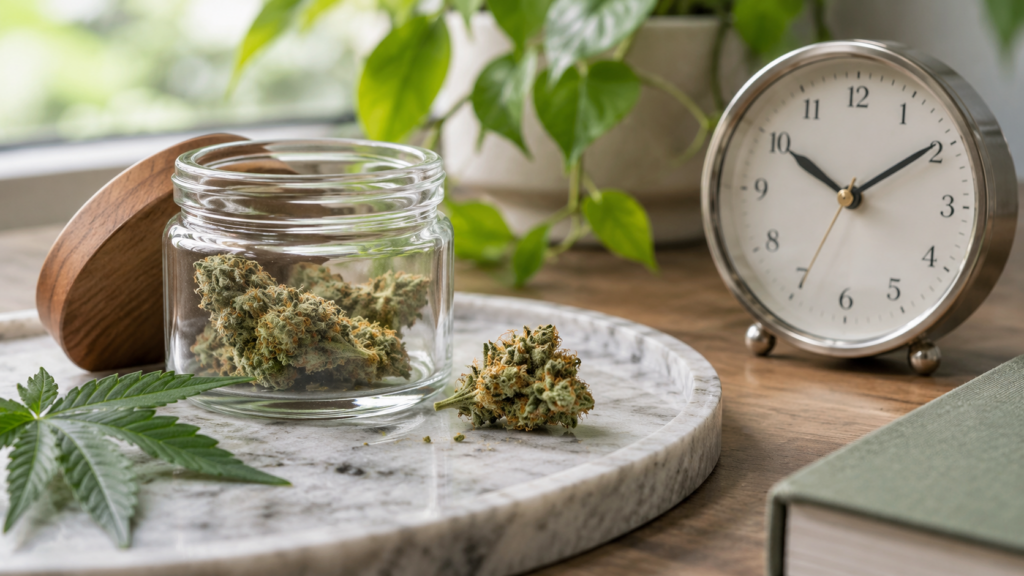
How long does a weed high last? The obvious effects of inhaled THC often fade over a few hours. Effects from swallowed cannabis can continue for much of a day, with lingering symptoms possible into the next day. Public-health guidance describes typical effects lasting around 2–4 hours after inhalation and 4–8 hours after oral exposure. These ranges are not upper limits; residual effects may persist longer. These are population-level descriptions, not personal recovery times. [1]
There is a difference between feeling less high and having your attention, coordination and judgment back to normal. If you've used THC, don't rely on a clock, a phone app or the way you feel to decide whether you can drive.
At High Society, we want this guide to answer the question without treating every person or product alike. Here is the evidence behind typical effects, lingering impairment and when to get help.
How long does a THC high last? Typical effects by route
THC, short for tetrahydrocannabinol, is a major intoxicating compound in cannabis. It affects brain systems that regulate memory, movement, attention and perception. A high is the everyday name for some of the sensations a person notices after exposure. Other changes, such as slower responses in a complex situation, may be harder to recognize.
Descriptions of the duration of a high differ because researchers and public-health organizations don't always measure the same thing. One may describe when people notice the strongest sensations, another may measure the whole period of acute effects, and a third may include residual changes that continue after the main experience.
| Exposure route | Typical acute effects | What the estimate does not tell you |
|---|---|---|
| Inhaled cannabis | Around 2–4 hours; longer effects are possible. | When attention and driving skills fully recover |
| Swallowed cannabis | Around 4–8 hours; effects can persist longer. | Whether further effects may emerge or whether impairment has ended |
| Lingering effects | Possible after either route, sometimes into the next day. | Whether symptoms are harmless or medical evaluation is needed |
Table summarizes the distinction between routes in public-health guidance [3]. It is not a dosing chart or a driving clearance table. On small screens, swipe horizontally to read all columns.
How long does a weed vape or smoked cannabis high last?
Inhaled THC can produce noticeable effects over a few hours, but recovery may take longer. Both smoke and vapor can deliver THC through the lungs. The device or physical form alone does not establish how much THC entered the body, how much was absorbed or how a particular person will respond. The concentration on a package is not a measurement of the person's blood concentration, and a different cartridge or flower label does not solve that uncertainty.
Vaping and smoking also carry their own health risks. A shorter perceived high should not be mistaken for a safer exposure. Research on concentrated THC products is still developing, and some effects remain inadequately understood. [4]
How long does an edible high last?
Edible cannabis effects commonly continue for several hours and may extend into the following day. Swallowed THC follows a different path through the body. Digestion and absorption take time, and the liver produces metabolites, including psychoactive 11-hydroxy-THC. A controlled 2017 study of oral cannabis measured THC and its metabolites in biological samples as well as participants' responses. [5] The practical safety concern is that a person may not realize the effects are still developing and may be exposed to more THC than intended.
This applies to gummies, infused foods and swallowed beverages. Product formulations differ, and marketing terms are not a substitute for evidence about an individual response. If an exposure is already causing concern, avoid taking more cannabis or adding other substances while you seek advice.
Three timelines: feeling high, impairment and THC detection
When someone asks how long being high lasts, they may actually be asking three different questions: when will I feel like myself, when will I be able to function normally, and when will THC no longer be detectable? These are not interchangeable.
What you notice: altered perception, anxiety, changes in concentration or a sense of intoxication.
Measured by self-report.
What you can reliably do: respond to hazards, divide attention or coordinate movement.
Measured through performance tasks.
What a biological sample contains: THC, its metabolites or both.
Measured through laboratory testing.
Self-reported intoxication is useful information, but it is incomplete. A person might feel calmer or more alert while still having difficulties with a demanding reaction-time task. Conversely, a biological test can remain positive after the noticeable intoxication has ended. Research examining driving and blood THC concentrations supports the need to keep these measurements separate. [6]
Two people may describe their symptoms very differently the next morning. Neither description establishes what a laboratory would detect or whether their performance has returned to baseline. The diagram organizes these questions; it is not a self-test.
What the August 2026 clinical trial found about cannabis impairment
A randomized clinical trial published in JAMA Network Open on August 31, 2026, investigated the relationship between edible THC and driving performance. The investigators analyzed 40 adults who regularly used cannabis. Each participant underwent multiple controlled sessions, including a placebo condition; the study was designed so neither participants nor the relevant study staff knew which exposure was assigned during testing. [7]
The researchers used a driving simulator rather than sending participants into real traffic. One outcome was how consistently a driver maintained their lateral position in a lane. Greater variation in that measure is evidence of reduced lane control. The study found a relationship between THC exposure and worse lane control at the two-hour and five-hour assessments.
Another noteworthy finding was that impairment could occur at blood THC concentrations below thresholds employed in some jurisdictions. A number on a test result did not reliably establish the ability to drive safely. The results are particularly relevant to the discussion of oral cannabis because it is possible to underestimate effects when relying only on how intoxicated a person feels.
What this trial cannot establish
The participants were regular adult users at a single research site, and the outcome was simulated driving. The findings cannot describe every patient, every formulation or real-world driving situation. The study observed changes in lane control at specific assessment times. It cannot identify the exact point at which an individual recovers. The study is not evidence that anyone becomes safe to drive at a particular hour.
Earlier research is useful here, too. A 2021 systematic review combined evidence on THC-related performance across driving and cognitive tasks. It found that the magnitude and duration of impairment differed by exposure route, individual use history and the task being studied. [8] A separate 2026 crossover study found that combining cannabis edibles and alcohol worsened driving performance compared with either alone. [9]
| Evidence | Useful conclusion | Limit |
|---|---|---|
| 2026 edible THC trial [7] | Driving-related changes can persist after oral exposure and occur at relatively low measured blood THC. | Controlled simulator results are not a personal recovery test. |
| 2021 systematic review [8] | Impairment duration differs across studies and types of tasks. | Research averages do not guarantee an individual's response. |
| 2026 alcohol combination trial [9] | Combined exposure creates additional safety concerns. | Does not define a safe combination or timing. |
The takeaway is not that everyone stays impaired for the same amount of time. It is that objective performance, felt intoxication and measured THC concentrations deserve separate consideration.
Why does the duration of a weed high vary?
There is no single clock inside the body that starts and stops with cannabis exposure. The formulation, the amount absorbed, individual metabolism, medicines and other substances all complicate the picture. Public-health information also identifies age, underlying health and previous cannabis exposure as factors that can influence a response. [3]
Product labels are not predictions
A package can provide information about cannabinoid content and ingredients. It cannot tell you how long a specific person will remain impaired. Terms such as indica, sativa and hybrid are not clinical categories of impairment or validated recovery times. Neither a strain name nor the hardware used to deliver THC is a reliable substitute for medical or safety guidance.
Previous experience is not protection
People sometimes report that familiar products feel different on different occasions. Regular exposure can affect subjective responses, but less noticeable intoxication does not mean that complex tasks have become risk-free. The 2026 trial is an example of why regular use should not be treated as proof of normal performance.
Other substances and health conditions matter
Alcohol can compound impairment, and medications or underlying health conditions may change a person's reaction. If there is a possible interaction with a prescription or over-the-counter medicine, contact a clinician or pharmacist rather than changing prescribed medication on your own. Tell them about any other substances involved.
Why am I still high? Lingering and next-day effects
Some people report lingering sleepiness, fogginess or difficulty concentrating after the main effects have faded. Public-health information recognizes that residual effects can extend into the next day. [10] That possibility does not mean everyone will be impaired the next morning, or that ongoing symptoms should automatically be attributed to cannabis.
A 2023 systematic review evaluated studies looking at performance more than eight hours after THC exposure. The available research did not consistently demonstrate next-day impairment, but differences in study quality and methods limited the conclusions. [11] That is a different question from whether an individual can have symptoms that continue overnight.
There are many other reasons someone may feel unwell or unable to focus, including lack of sleep, illness or another substance. Persistent, worsening or unusual symptoms warrant professional advice. If you still feel affected, avoid driving, operating machinery and other tasks where an error could hurt someone. In California, it is illegal to drive under the influence of cannabis. [12]
How long does THC stay in your system compared with a high?
No. Laboratory detection and current intoxication refer to different things. Urine, blood and oral fluid testing do not necessarily measure the same chemical or answer the same question. THC metabolites may remain detectable after the noticeable effects have disappeared. [16]
A meta-regression of blood and oral-fluid cannabinoid concentrations and impairment examined the limitations of using such measurements to predict performance. [13] A positive result is not a precise measure of how a person feels at that moment, and a low result is not proof of driving fitness. Different testing methods and thresholds also make comparisons between results difficult.
| Misconception | More accurate explanation |
|---|---|
| Feeling sober means all effects have ended. | Self-perception and measured performance are different outcomes. |
| A positive test means a person is definitely high. | Detectable compounds can remain after felt effects disappear. |
| A certain number of hours guarantees recovery. | Research does not provide an individual clearance countdown. |
| A product name predicts the duration. | Labels and branding are not validated measures of individual impairment. |
This guide deliberately does not provide a drug-test countdown. If a test relates to medical care, employment or a legal issue, ask the appropriate professional what the result means for that specific situation.
What to do if cannabis effects feel overwhelming
Feeling anxious, dizzy or confused after cannabis can be distressing. Stop further exposure, move away from hazards and ask a sober, trusted person to stay with you if possible. Do not use alcohol, more cannabis or another drug in an attempt to counteract the effects. There is no established home remedy that reliably reverses cannabis intoxication.
For unexpected or concerning symptoms in the United States, call 1-800-222-1222 or use the poison exposure advice resource [14]. Keep the package or label available for medical personnel if you have it. If a child may have ingested cannabis, contact Poison Control immediately even if symptoms have not started; do not wait for symptoms to become obvious.
Edible cannabis can be mistaken for ordinary food. Store cannabis securely, in its original labeled packaging, away from children and pets. If a pet may have been exposed, seek veterinary advice promptly. [15]
Frequently asked questions
How long does a THC high usually last?
Noticeable effects often last several hours, depending on the route of exposure and the person. Swallowed cannabis may produce effects that persist longer than inhaled cannabis. Neither feeling better nor the passage of an estimated number of hours establishes that impairment has ended.
Can an edible high last until the next morning?
Yes, lingering effects are possible. If symptoms are persistent, severe or getting worse, seek medical advice. Avoid driving or safety-sensitive activities while affected, and do not assume that sleep alone has resolved the effects.
Does a weed vape high always end sooner than an edible high?
Inhaled and swallowed cannabis show different general timing patterns, but there is no dependable way to predict an individual's recovery from the format alone. Both routes can impair judgment and coordination.
Why do I feel normal but still have trouble concentrating?
Different aspects of brain function may recover at different times. Feeling less intoxicated does not guarantee that attention or other skills have returned to normal. Other health issues may also affect concentration, so seek advice if problems persist.
Can coffee, a shower or food make a cannabis high end faster?
There is no reliable evidence that these measures reverse THC-related impairment. Avoid trying to counteract intoxication with other substances. For concerning symptoms, contact a medical professional or Poison Control rather than relying on a home remedy.
Can a blood THC result tell me if I am safe to drive?
No single blood THC concentration can establish an individual's driving fitness. The 2026 clinical trial found performance changes at relatively low concentrations. Do not use a test result or a timer as permission to drive.
Should I get help if a high lasts longer than expected?
Yes, particularly if you are worried about the symptoms, the amount involved or possible interactions. Contact Poison Control or a health professional for individual guidance. Emergency symptoms such as trouble breathing, seizures or inability to wake someone require 911.
Can a weed high last 24 hours?
Some residual effects can extend into the following day. Persistent intoxication or unusual symptoms should not be assumed to be normal. If you are worried, follow the medical help guidance rather than waiting for a fixed time to pass.
Understanding duration without guessing at recovery
There is a scientific basis for describing general differences in the duration of cannabis effects. But there is no reliable personal countdown that tells you when every effect will disappear. The most important distinction is between subjective intoxication, measurable impairment and chemical detection. Each describes something different.
For readers in Orange County and elsewhere, that distinction is more useful than a promise of a precise number of hours. Take unexpected symptoms seriously, seek professional advice when needed, and do not treat a general timeline as a safety clearance.
Publisher background: About High Society Cannabis Co. This guide is general educational information, not medical or legal advice. It has not undergone independent clinical review. The research date is not a medical review date. Questions about symptoms or health should go to a qualified clinician, not a retailer.
Scientific references and source notes
We consulted public-health guidance for general duration and emergency advice, controlled trials for performance findings, and systematic reviews for consistency across studies. The August 2026 study citation was checked against its journal listing and indexed archive. This is a narrative educational review, not a systematic literature search or independent clinical assessment.
- Consumer information about cannabis: general effect timelines.
- Emergency poison-exposure guidance.
- Consumer guidance: cannabis effects and individual response.
- Cannabis health information and frequently asked questions.
- Vandrey R et al. (2017). Pharmacokinetic Profile of Oral Cannabis in Humans: Blood and Oral Fluid Disposition and Relation to Pharmacodynamic Outcomes. Journal of Analytical Toxicology.
- Cannabis and driving: public-health evidence.
- Le Foll B et al. (August 31, 2026). Dose-Dependent Effects of Cannabis Edibles on Simulated Driving Performance: A Randomized Clinical Trial. JAMA Network Open. DOI: 10.1001/jamanetworkopen.2026.31306.
- McCartney D et al. (2021). Determining the magnitude and duration of acute THC-induced driving and cognitive impairment: A systematic and meta-analytic review. Neuroscience & Biobehavioral Reviews.
- (2026). Impact of Cannabis Edibles Combined With Alcohol on Driving, Field Sobriety Performance, and Subjective Effects. JAMA Network Open.
- Short- and long-term health effects of cannabis.
- McCartney D et al. (2023). The “Next Day” Effects of Cannabis Use: A Systematic Review. Cannabis and Cannabinoid Research.
- California cannabis consumer law guidance.
- McCartney D et al. (2022). Are blood and oral fluid THC and metabolite concentrations related to impairment? A meta-regression analysis.
- Cannabis-related poisoning and exposure advice.
- Cannabis poisoning and child safety.
- Clinical education resource: cannabis effects, functioning and detection.